LAC: Capacity building and training
Our motto is ‘dare to share’, which we put into practice through our open source and freely available software, the emphasis on collaborative development, capacity building and hands-on training.
Hands-on training is part and parcel of almost all our projects and research programs, through collaborative modelling and planning, short courses, peer to peer workshops and communities of practice. The Latin America FEWS days, attended by some 50 practitioners in the region, is a prime example, by combining course-drive training, experience sharing sessions, presentations and actively stimulating peer-to-peer learning and cooperation.
In addition, we work with dedicated education institutes such as IHE Delft and our partners in the region, to deliver tailor made courses, in the Netherlands and the region.
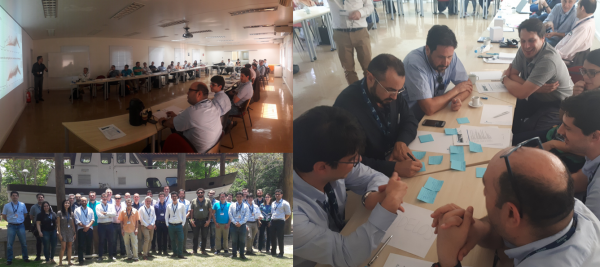
Examples of our recent work include:
- UNGRD Tailor-Made Training programme on Integrated flood and drought risk management: prevention, warning and response for the National Risk Management Agency (Colombia). Contact person: Nathalie Asselman.
- Integrated Water Resources Management course for senior Colombian Water Managers (Colombia). Topics included framework of analysis for National level Water Management programmes (Room for the River, Delta Programme), Modelling for Analysis and Decision-making, Governance, Financing and Participation. Contact person: William Oliemans.
- Training course on groundwater modelling and hydrological forecasting systems for ANA (Peru). Topics also included derivation of reservoir operating curves and optimization of multi-objective reservoir systems for integrated water resources management using model predictive control techniques.
- Training workshop on ‘Flood Risk Policy Analysis and Planning’ for the Tabasco government, national and local stakeholders (Mexico). Contact persons: Nathalie Asselman.