GeoCentrifuge
Physical research into the interaction between soil and structures is regularly carried out to scale in laboratories. Depending on the phenomena to be studied, this scaling need not be a problem for the results, but if, for instance, soil and pore water pressures in a scale model need to be well comparable with reality, the GeoCentrifuge can help. The GeoCentrifuge is a unique geotechnical test facility, and it can generate up to 150g. In combination with the large dimensions of the centrifuge platform, this puts it in the top three in Europe.
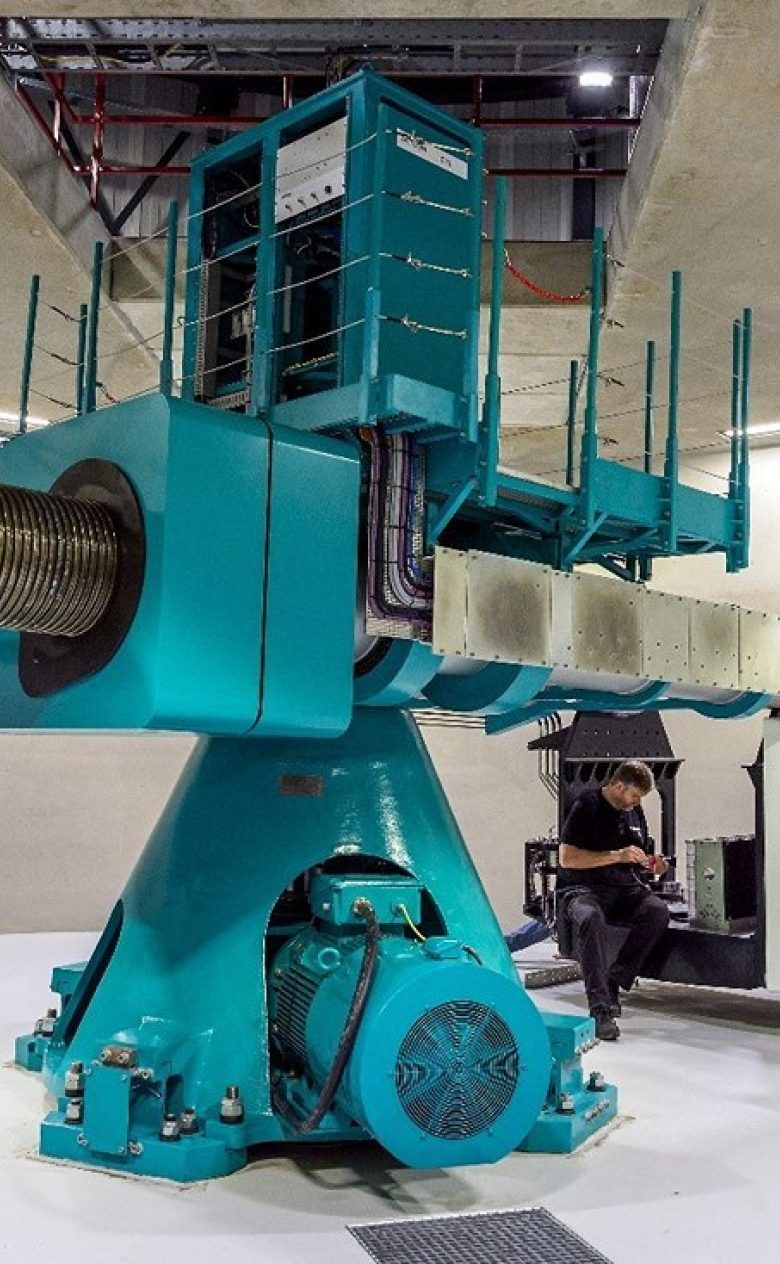
"Blowing up" scale models to actual proportions
Among other things, the Deltares GeoCentrifuge offers the possibility of "blowing up" scale models to actual proportions in terms of stresses and size. This will allow a scaled-up dyke of, say, 10cm high to behave like an actual dyke of 10m high at 100g.
This scaling combined with increasing gravity can also significantly accelerate geotechnical processes such as the consolidation ofclay and peat, for example. This creates a wide range of new possibilities that would not have been possible without a GeoCentrifuge.
Gravity at 150g
The Deltares Geocentrifuge can generate a gravity of up to 150g and has a capacity of 260g-tonnes. This large capacity combined with a large platform radius of 5m and the platform measuring 1.2m x 1.2m x 1.8m (l x w x h) provides the ability to test relatively large-scale models at the desired g-level.
By using the GeoCentrifuge in combination with the ample knowledge and experience of researchers and technicians, large practical situations can be correctly scaled, relatively quickly and cost-effectively. This allows designs and knowledge gaps, for example, to be tested and identified quickly and efficiently.
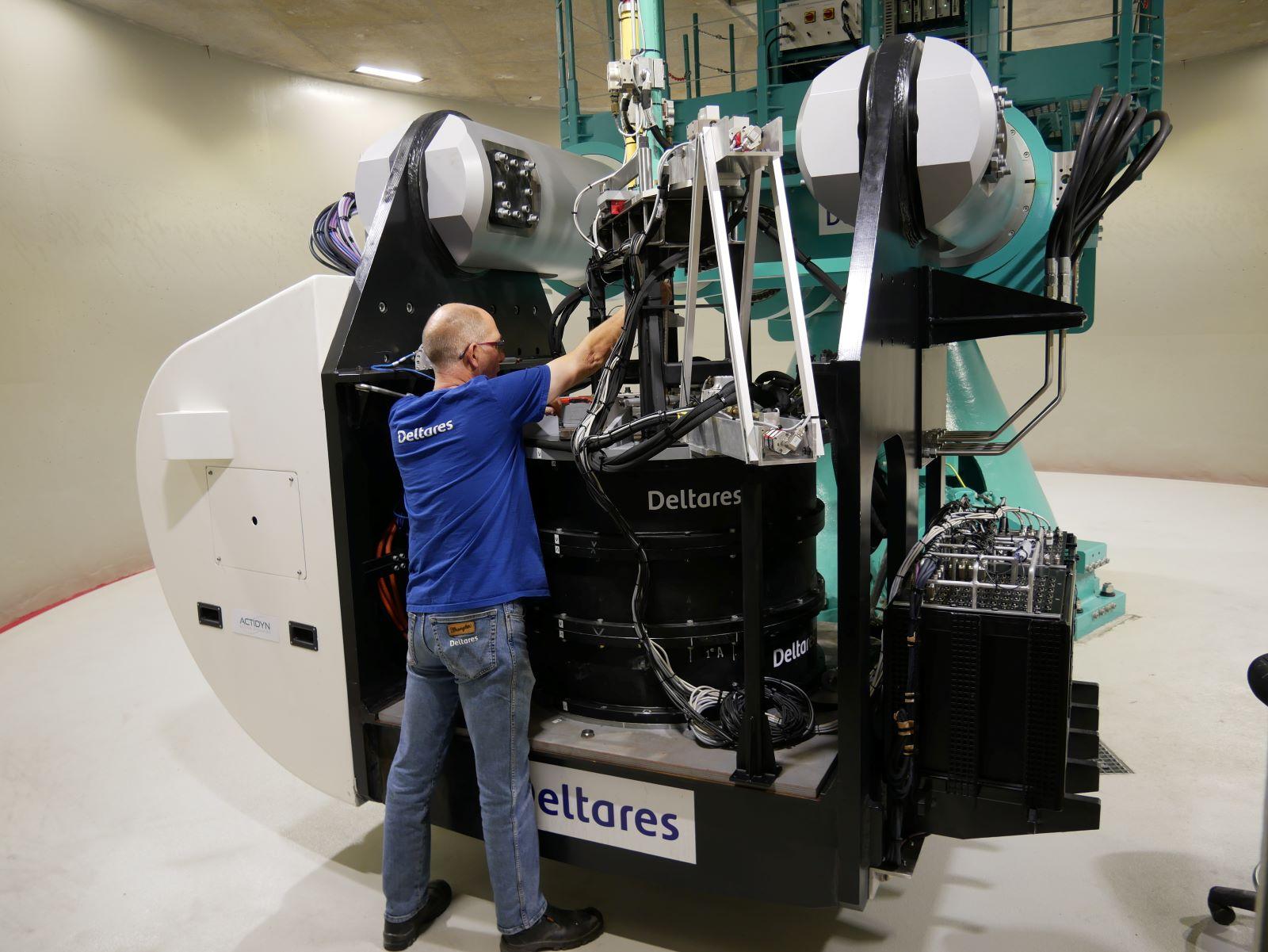
Recent experiments
Examples of recent experiments:
- Investigating the behaviour of wind turbine foundations under varying wind loads
- The behaviour of peat under load (video)
- Research into the "uplift" failure mechanism of embankments (video)
- The effect of loads on underground (pipe) pipes
- Research into mudslides (video)
- The influence on each other's bearing capacity of foundation piles in group installation
GeoCentrifuge specifications
- Maximum g-level 150
- Platform radius 5m
- Maximum model dimensions 1.2m x 1.2m x 1.8m (l x w x h)
- Capacity of 260g-tonnes
- Real time in-flight 56-channel data acquisition
- Real time in-flight video acquisition (high-speed and/or high-resolution including illumination)
- Real-time in-flight control and influence of actions, processes and/or instruments
- 24 and 48V, compressed air, water, vacuum, and hydraulic pressure available on platform
Video: The installation of the GeoCentrifuge
You have not yet indicated whether you want to accept or reject cookies. This means that this element cannot be displayed.
Or go directly to: